
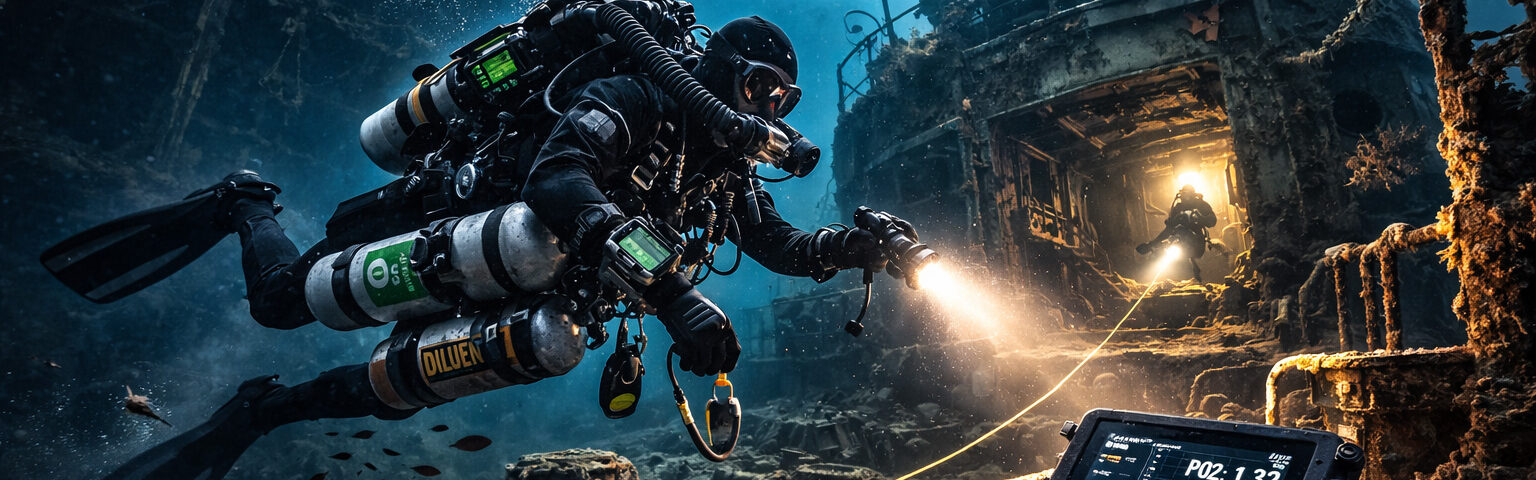
For decades, the image of the technical diver was synonymous with heavy, twin-manifold steel cylinders and a tangled web of stage bottles clanking against their sides. But as expedition depths increase and the demand for longer, more complex bottom times grows, the open-circuit paradigm is reaching its logistical limits. Enter the Closed-Circuit Rebreather (CCR)—once considered the fringe domain of military frogmen, it is now the standard vehicle for elite underwater exploration.
The Mechanics of the Loop
Unlike open-circuit scuba, where every exhalation is wasted as bubbles racing to the surface, a CCR recycles the diver’s breath. The exhaled gas travels through a “loop” where it passes through a chemical scrubber canister to remove toxic carbon dioxide. Simultaneously, an onboard computer monitors the partial pressure of oxygen (PO2) and triggers a solenoid to inject fresh oxygen, keeping the breathing loop perfectly optimized for the diver’s depth.
Agencies like the Rebreather Association of International Divers (RAID) emphasize that this dynamic gas blending provides unparalleled physiological advantages. Because the inhaled gas is warm and moist (a byproduct of the chemical scrubbing reaction), divers lose significantly less core body heat and suffer less from the dehydrating effects of breathing compressed cold air.
“Diving a rebreather fundamentally changes your relationship with the ocean. Without the mechanical roar of exhaust bubbles, marine life ceases to view you as an intruder.”
Optimized Gas Logistics and Decompression
The true power of the CCR lies in its decompression efficiency. In an open-circuit setup, your gas mix is fixed. On a rebreather, the computer is constantly adjusting the mix to provide the absolute optimal “best gas” for every inch of the water column. This actively accelerates off-gassing during the ascent profile.
Furthermore, the logistical footprint on the dive boat shrinks dramatically. Instead of hauling a dozen heavy tanks for a trimix dive, a CCR diver requires only two small 3-liter cylinders (one for oxygen, one for diluent) and a bailout tank. According to advanced training protocols from Technical Diving International (TDI), mastering the CCR demands a shift from physical exertion to extreme mental discipline and rigorous pre-dive checklists.
Looking Ahead
As we continue to profile deep-wreck and cave expeditions throughout the year, expect to see the CCR taking center stage. In an upcoming feature, we will break down the differences between electronic (eCCR) and manual (mCCR) units to help you decide which path your technical training should take.