
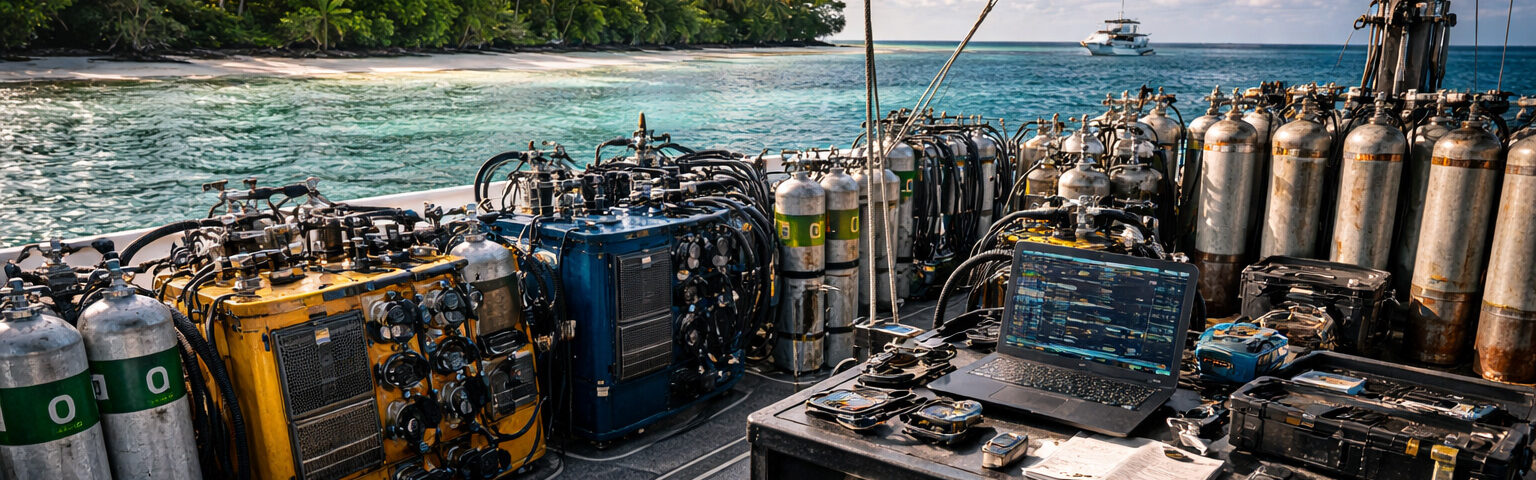
Executing a technical dive profile in an established hub like Florida or the Red Sea is a matter of scheduling. Executing that same profile on a remote, uninhabited Pacific atoll is a matter of absolute, uncompromising logistical mastery. When your dive site is a three-day steam from the nearest port, the margin for mechanical or physiological error drops to zero.
Compressor Redundancy and Gas Blending
The most critical bottleneck of any remote expedition is the gas supply. Unlike coastal diving where tanks are dropped at a local shop for a fill, a liveaboard or remote shore camp must function as a self-sustaining blending station. This requires continuous-flow mixing panels, medical-grade oxygen banks, and helium cylinders shipped in months in advance.
More importantly, it requires compressor redundancy. A seized piston on your primary compressor effectively terminates the entire expedition if there is no backup. According to the operational guidelines set by the Rubicon Foundation for remote hyperbaric operations, staging must include at least two independent gas delivery systems, alongside abundant replacement filters and specialized compressor lubricants that are impossible to source locally.
“On a remote atoll, your maximum depth isn’t dictated by your courage; it is strictly governed by the reliability of the surface support vessel operating above you.”
Evacuation Protocols and Chamber Access
Beyond the breathing gas, expedition leaders must heavily audit their emergency evacuation protocols. In the event of decompression sickness (DCS), the standard protocol of calling a helicopter is often impossible due to aircraft range limits.
Expedition planners must coordinate with organizations like the Divers Alert Network (DAN) months in advance to verify the operational status of the nearest hyperbaric chamber. Often, “nearest” still means a 48-hour boat transit. Consequently, remote technical teams must carry extensive onboard medical oxygen supplies—far exceeding standard recreational limits—to sustain a stricken diver on surface oxygen for days, not hours, during transport.
The Final Frontier
The reward for this exhausting logistical puzzle is unparalleled access to virgin reef systems and undisturbed wrecks. In our next expedition dispatch, we will be breaking down the specific pelagic encounters and structural mappings from our recent staging in the deep southern atolls.