
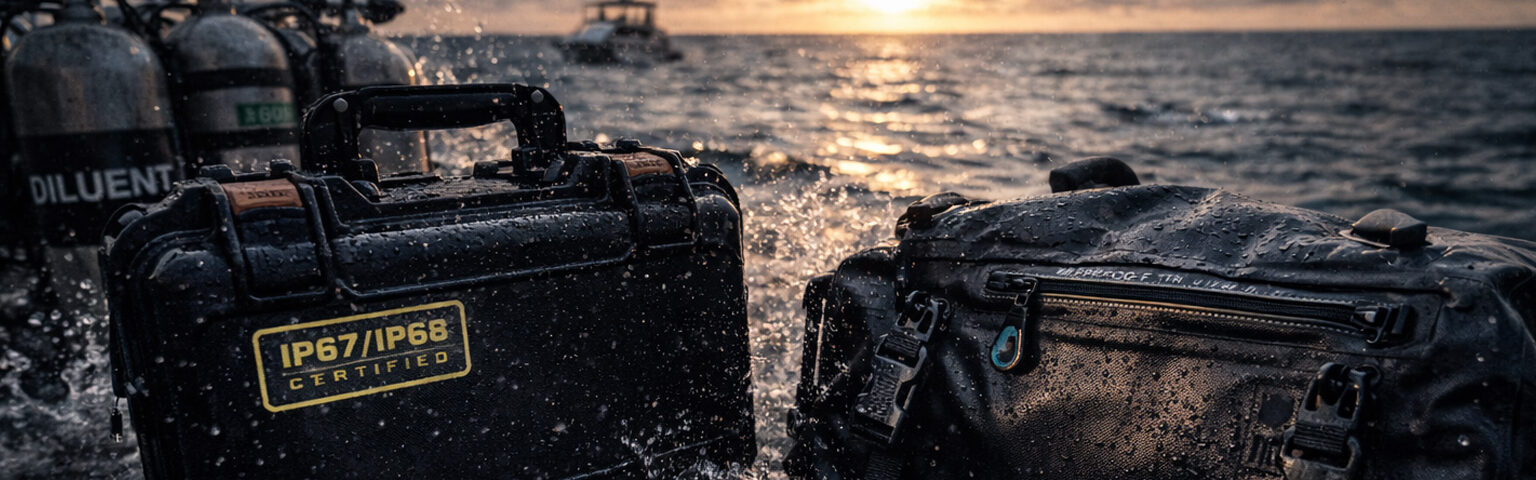
The modern technical diver carries thousands of dollars of sensitive electronics before they even step foot on the dive deck. From dive computers and CCR controllers to primary lighting and backup lithium-ion cells, the modern expedition runs on telemetry. However, the greatest threat to this equipment rarely occurs at 200 feet—it happens on the transit out, where relentless sea spray and atmospheric salt quickly degrade sensitive internal components.
The IP Rating Standard
Not all waterproof gear is created equal, and for technical applications, “water-resistant” is simply not sufficient. When evaluating dry storage, explorers must look to the Ingress Protection (IP) rating system. For top-tier marine environments, an IP67 or IP68 rating is the minimum acceptable standard, ensuring the bag or case is completely dust-tight and capable of surviving complete continuous submersion in saltwater.
According to the International Electrotechnical Commission (IEC), standard roll-top PVC dry bags—while excellent for isolating wet wetsuits post-dive—are prone to micro-leaks if the top is not perfectly folded and purged of air. For mission-critical electronics, submersible duffels utilizing airtight, hydrostatic TRU-Zip or YKK AquaSeal zippers are rapidly replacing the traditional roll-top design.
“Saltwater is a highly conductive, corrosive inevitability. The goal is not merely to keep the water out, but to create an absolute atmospheric quarantine for your telemetry.”
Hard Cases and Pressure Equalization
For the most fragile components, such as camera domes, regulators, and spare shearwater transmitters, soft-sided dry bags offer zero crush protection against heavy twinsets rolling on a pitching boat deck. This is where polymer hard cases become mandatory.
A true marine-grade hard case features an O-ring seal and an automatic pressure equalization valve. This valve—often utilizing a Gore-Tex membrane—allows air pressure to equalize during flights or rapid temperature changes on the boat, preventing the case from vacuum-sealing shut, while still completely blocking water molecules. Leading manufacturers test these cases to strict military drop-standards to ensure the resin shell will not fracture under heavy blunt force.
The Modular Loadout
As we prepare for the upcoming wreck diving season, the Dive Ledger team is auditing a new series of modular, interlocking dry cases that perfectly separate wet gas-blending tools from dry electronics. Expect a full review of our preferred “boat-proof” loadouts in the coming weeks.