
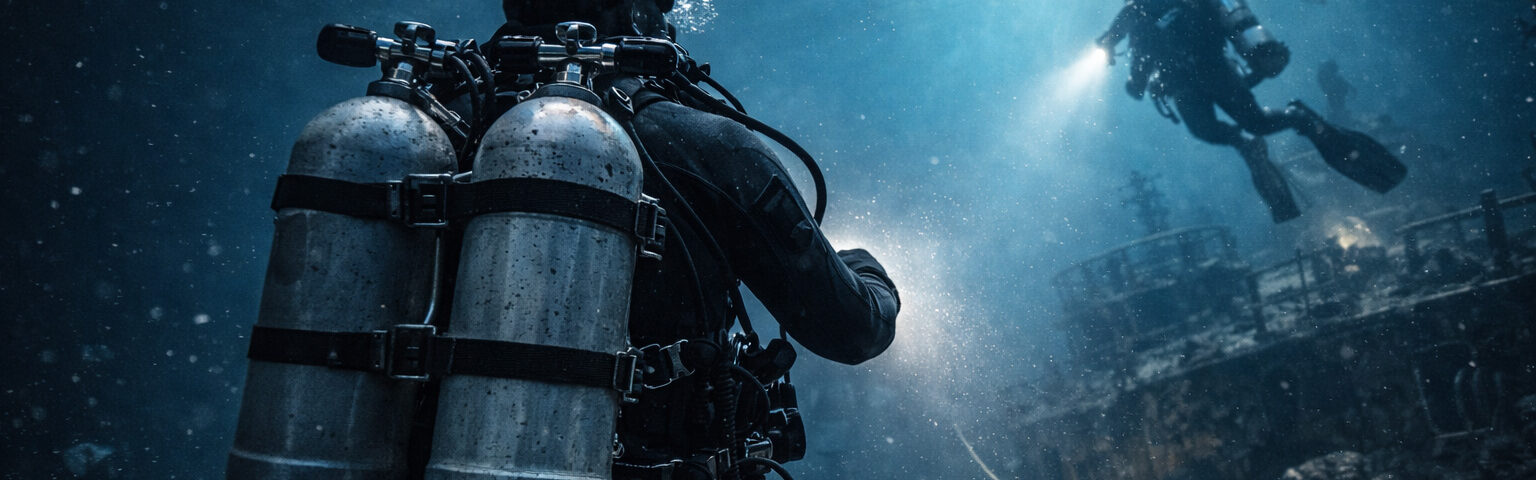
For decades, the silhouette of a technical diver was defined by the heavy, manifolded twinset resting squarely on their back. Today, that paradigm is being aggressively challenged. The rise of sidemount diving—a configuration originally developed by British sump divers squeezing through dry cave systems—has transitioned from a niche survival tactic into a mainstream technical standard.
The Case for the Traditional Twinset
Backmount diving remains the undisputed workhorse of open-water technical exploration. Its primary advantage lies in gas management simplicity. A set of double cylinders connected by an isolation manifold allows the diver to breathe from both tanks simultaneously through a primary regulator. If a catastrophic failure occurs—such as a blown O-ring or a free-flowing first stage—the diver can reach behind their head, isolate the tanks by closing the center valve, and preserve the remaining gas in the intact cylinder.
According to standard protocols from the International Association of Nitrox and Technical Divers (IANTD), backmount excels in environments where restrictions are minimal and heavy stage bottles (such as multiple trimix and deco blends) need to be easily clipped to chest D-rings without cluttering the diver’s lateral profile.
“A manifolded twinset is the brute-force solution to deep water: rigid, undeniably heavy, and historically proven.”
The Sidemount Advantage
Conversely, sidemount removes the tanks from the diver’s back and suspends them under the armpits, running parallel to the torso. This creates a remarkably hydrodynamic, low-profile trim. The immediate benefit is accessibility: the tank valves, first stages, and routing hoses are directly in the diver’s line of sight, eliminating the need to perform complex “valve drills” behind the head.
For deep wreck penetration or complex cave navigation, sidemount offers unmatched flexibility. If a corridor narrows, a diver can unclip the bottom of the cylinders, push them forward, and slide through spaces barely wider than their own shoulders. However, as noted by the NSS-CDS, this configuration requires a much higher degree of task loading, as the diver must manually switch regulators every few hundred PSI to ensure the tanks drain evenly and maintain horizontal balance.
Choosing Your Configuration
Ultimately, the choice between backmount and sidemount is dictated by the environment. If your expedition involves plunging into the open ocean to hit a deep seamount, the twinset is a logistical powerhouse. If you are penetrating the rusted, collapsing corridors of a sunken freighter, the low profile and modularity of sidemount provide the ultimate tactical advantage.