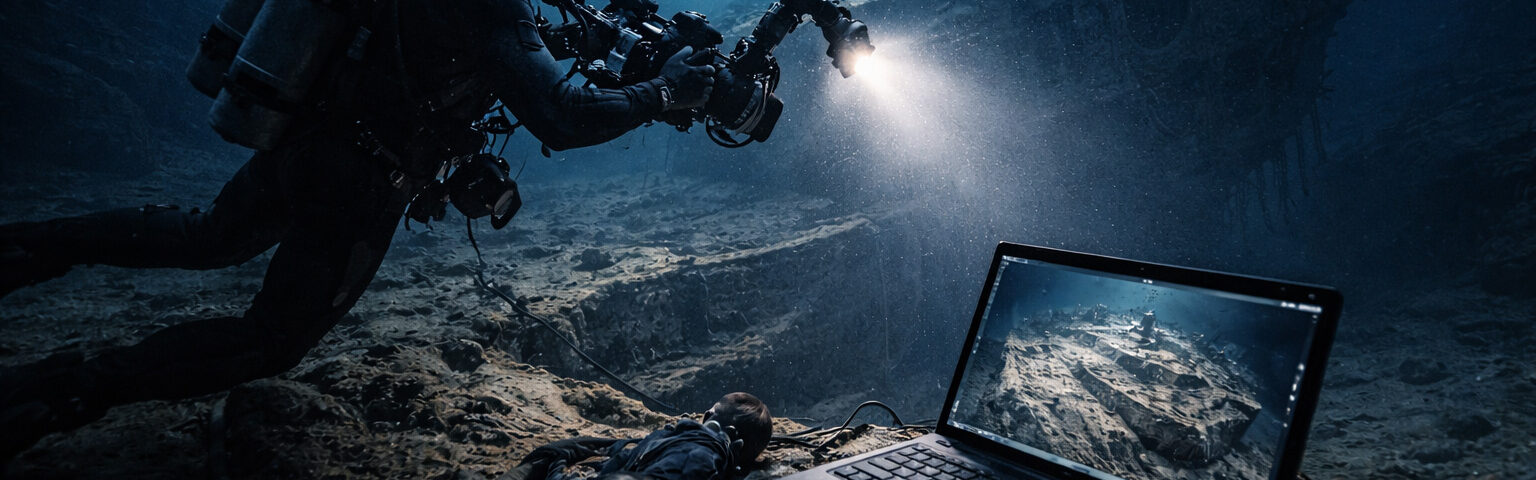
For decades, the standard protocol for documenting a newly discovered wreck involved slate sketches, physical measuring tapes, and a significant amount of interpretive guesswork. Today, the convergence of high-capacity underwater lighting and advanced rendering software has ushered in the era of 3D photogrammetry, transforming how technical divers record and preserve maritime history.
Rendering the Abyss
Photogrammetry is the science of making measurements from photographs. In a wreck diving context, it requires a diver to swim a meticulous, grid-like pattern over the site, capturing thousands of high-resolution, overlapping images. Back on the surface, specialized software stitches these data points together to create a millimeter-accurate 3D digital twin of the wreckage.
This technique allows researchers to study deep-water sites that are otherwise constrained by extreme depth and limited bottom times. Organizations like the Nautical Archaeology Society (NAS) are increasingly relying on these digital models to monitor structural degradation over time, tracking how metal hulls collapse under the relentless pressure and salinity of the ocean.
“We are no longer just visiting these submerged monoliths; we are lifting them out of the dark and into the digital light for permanent preservation.”
The Equipment Requisites
Capturing a massive dreadnought requires more than just a standard action camera. It demands a serious investment in domed ports, wide-angle rectilinear lenses, and, most importantly, powerful video lights capable of punching through the ambient gloom without creating “snowstorm” backscatter.
Agencies like Global Underwater Explorers (GUE) have pioneered team-based photogrammetry protocols, where lighting divers hover precisely off-axis from the camera operator to illuminate the hull evenly. In our upcoming dispatch, we will break down the exact camera tray configurations and buoyancy techniques used by these elite documentation teams.