
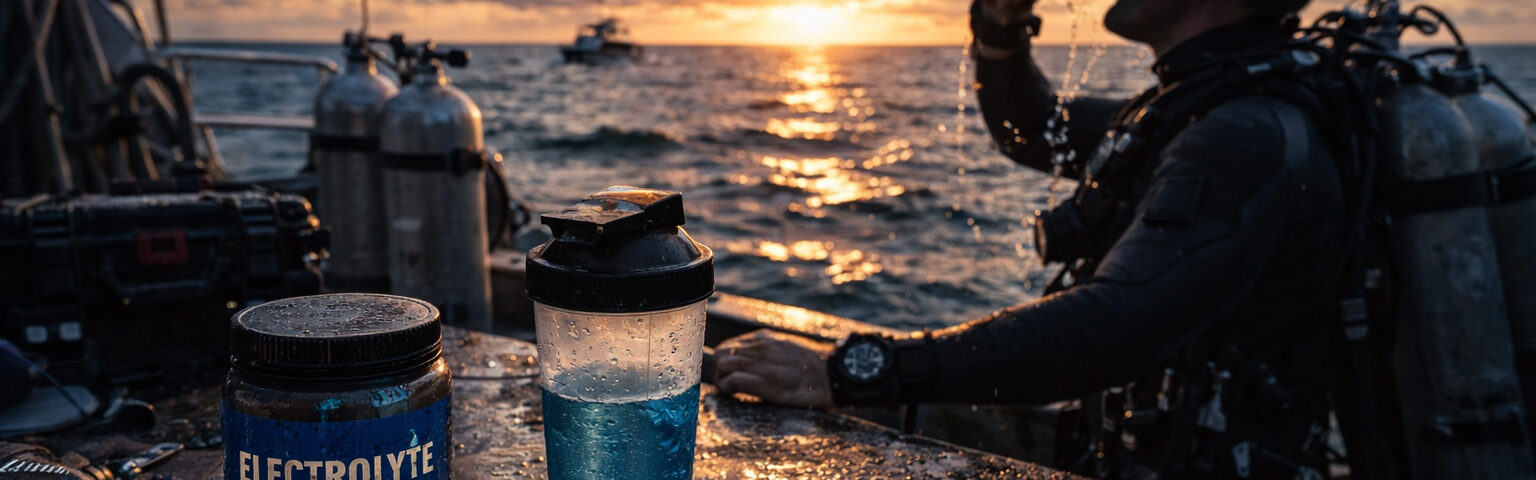
Technical divers will spend hours analyzing gradient factors, meticulously blending trimix, and running bailout scenarios. Yet, one of the most significant physiological factors contributing to decompression sickness (DCS) is frequently overlooked on the dive deck: baseline hydration. In the realm of extended bottom times, water intake is just as critical as your gas management strategy.
Blood Plasma and Efficient Off-Gassing
The mechanics of decompression rely entirely on the circulatory system’s ability to transport dissolved inert gases (like nitrogen and helium) from the bodily tissues back to the lungs for expiration. When a diver is dehydrated, blood plasma volume drops. This causes the blood to thicken (an increase in hematocrit), which sluggishly impedes the perfusion rate.
Simply put: thick, dehydrated blood cannot efficiently carry micro-bubbles out of your system during ascent. According to hyperbaric research published by the Undersea and Hyperbaric Medical Society (UHMS), even mild systemic dehydration can exponentially increase the risk of sub-clinical DCS, transforming a perfectly executed computer profile into a physiological emergency.
“Decompression sickness is fundamentally a biomechanical failure of the circulatory system; proper hydration is the essential lubrication that prevents it.”
Diuretics and the Expedition Routine
The logistics of global dive travel often work against proper hydration. Long-haul flights, prolonged exposure to the sun on open boat decks, and the diuretic effects of the mandatory pre-dive coffee all actively deplete the body’s water reserves. Furthermore, the physiological phenomenon known as immersion diuresis—where the hydrostatic pressure of the water forces fluid to the body’s core, prompting the kidneys to produce urine—accelerates fluid loss while submerged.
To combat this, leading physiologists at the Divers Alert Network (DAN) recommend a proactive hydration protocol starting 24 hours before a technical dive. This involves consuming electrolyte-balanced fluids rather than just plain water, ensuring the body actually retains the moisture at a cellular level rather than immediately flushing it out.
The Pre-Dive Protocol
As you prepare your gear for the next expedition, audit your personal physiology just as ruthlessly as your regulators. A well-hydrated diver is a safer diver, capable of maximizing their time at depth while minimizing the invisible stresses of the ascent.