
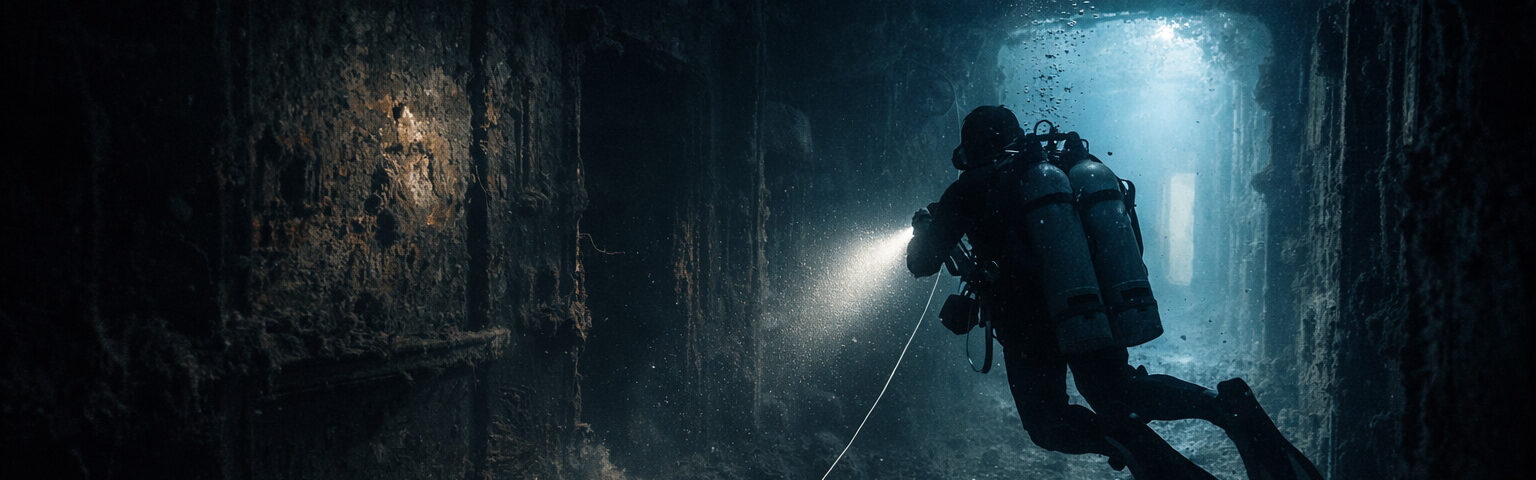
There is a distinct psychological threshold that is crossed the moment a diver leaves ambient sunlight and enters the rusted hull of a submerged wreck. For the technical explorer, a deep wreck is not merely a historical artifact; it is a complex overhead environment that demands absolute precision in buoyancy, gas planning, and situational awareness.
The Logistics of Penetration
Unlike open-water reef diving, wreck penetration introduces hard ceilings and zero direct access to the surface. Entering these environments requires a shift from standard recreational gear to redundant technical configurations, such as twinsets or sidemount setups, ensuring that a single point of failure does not become catastrophic.
Before any line is run, comprehensive dive planning is mandatory. Organizations like Technical Diving International (TDI) stress the importance of the “Rule of Thirds” for gas management during penetration: one-third of your gas for ingress, one-third for egress, and one-third held in reserve for emergencies. In deep wreck scenarios, this calculation must also account for accelerated decompression schedules upon exit.
“In the corridor of a sunken dreadnought, your primary lifeline is not your regulator, but the continuous guideline leading you back to the light.”
Silt Management and Zero-Visibility Protocols
Perhaps the most insidious danger within a wreck is the invisible layer of particulate matter coating the floors and bulkheads. A single careless fin kick—or even the exhaust bubbles hitting a rust-flaking ceiling—can trigger a “silt-out,” reducing visibility to absolute zero in seconds.
Proper trim and propulsion techniques are non-negotiable. The modified frog kick and helicopter turn are essential to keeping thrust directed backward rather than downward. If a silt-out does occur, panic is the enemy. According to incident reports analyzed by the Divers Alert Network (DAN), the successful resolution of a zero-visibility event relies entirely on tactile contact with a properly laid guideline and the discipline to execute a blind, touch-contact exit with your team.
The Staging Ground
Our upcoming field reports will document the structural integrity and mapping of several WWII-era wrecks in the Pacific theater. Until then, ensure your reels are spooled, your primary lights are charged, and your dive plans are calculated with absolute conservatism.