
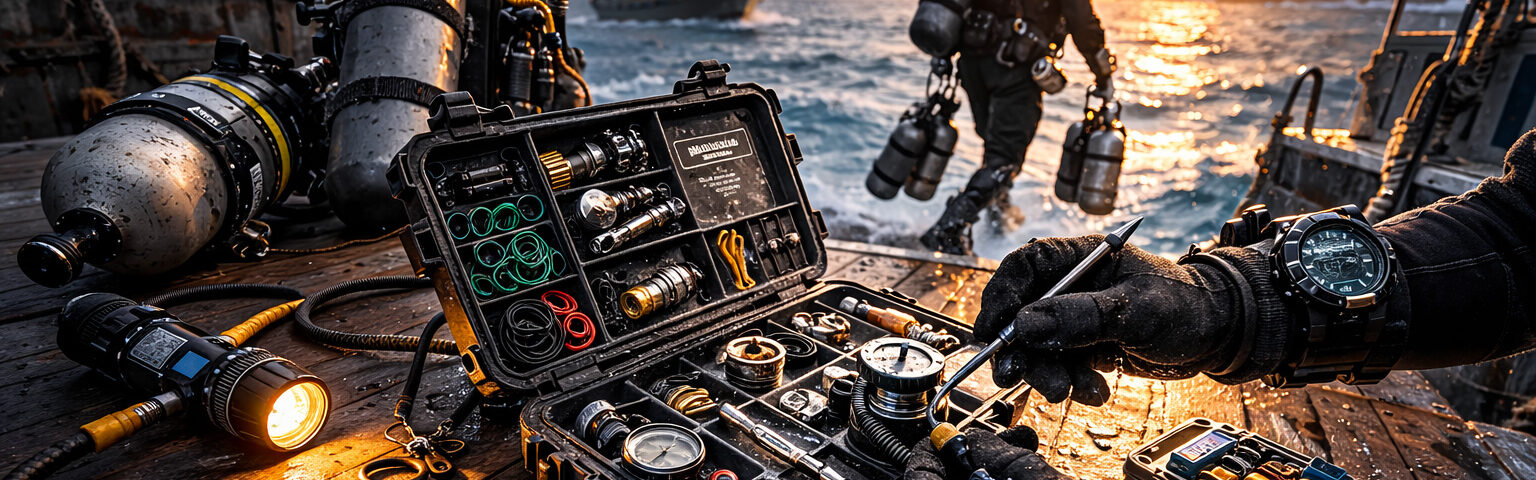
There are few things more frustrating than meticulously planning a deep-water expedition, charting the logistics, and paying for the charter, only to have the entire dive scrubbed by a blown high-pressure O-ring. For the technical diver, redundancy doesn’t stop at the breathing gas; it extends directly to the equipment maintenance staged on the deck.
The Foundation of Field Repair
A properly audited “Save-a-Dive” kit is the cheapest insurance policy an explorer can carry. While recreational kits often contain little more than a spare mask strap and a snorkel keeper, the modern technical kit must be equipped to handle complex regulator failures and telemetry drops.
The foundation begins with the basics: a comprehensive assortment of Viton O-rings (compatible with oxygen-rich Nitrox blends), a brass O-ring pick, and a multi-tool configured with the exact hex keys required for your specific first stages. According to equipment reliability guidelines established by PADI, having the ability to reseat a high-pressure port plug on the fly can mean the difference between an hour of bottom time and a day sitting on the surface.
“True redundancy is the quiet confidence that a mechanical failure on the boat will not dictate the outcome of the expedition.”
Cutting Tools and Hardware
Beyond pneumatics, your kit must account for entanglement hazards and hardware failures. Double-ended bolt snaps are notorious for seizing after prolonged saltwater exposure. Carrying two to three spare marine-grade stainless steel snaps, along with a length of #24 braided nylon cave line, allows you to re-rig a stage bottle or a primary light in under five minutes.
Additionally, redundant cutting tools are essential. We recommend keeping a fresh set of trauma shears or a ceramic trilobite cutter in the dry box. As noted in safety audits by the National Speleological Society Cave Diving Section (NSS-CDS), the ability to quickly slice through heavy monofilament or degraded netting is a non-negotiable safety standard for overhead and deep-wreck environments.
Telemetry Backups
Finally, as we dive deeper into the biometric and wireless era, battery redundancy is critical. CR2 batteries for wireless air transmitters, alongside the proprietary charging pucks for your dive computers, must be sealed in a watertight, crush-proof case.
In an upcoming feature, the Dive Ledger team will be reviewing the top three modular dry boxes designed specifically for organizing these critical small-ticket items.